Overview
Expensive, heavy and widely considered worth it: the kitchen appliance owners famously keep using for decades.
We researched the Artisan Series 5-Quart Tilt-Head Stand Mixer from KitchenAid against the criteria we use for this category: manufacturer specifications, patterns in verified owner reviews, independent testing published by others, and warranty and parts support. We do not test products in-house; what follows is our analysis, including the trade-offs that tend to show up only after the first few weeks of ownership.
Key features
Metal construction
A die-cast metal body and a direct-drive transmission. The weight and metal housing are what keep it planted under load, and build quality is the area where budget mixers most often fall short.
Planetary mixing action
The beater travels around the bowl while spinning on its own axis, reaching the sides and base. The design produces far more even mixing than a stationary-head mixer.
A huge attachment ecosystem
The front power hub takes pasta rollers, grinders, spiralizers and more. The attachments are not cheap, but they turn one motor into a whole prep station.
Parts availability for decades
Bowls, beaters, gaskets and service parts for older machines are still widely sold. Long-term serviceability is a feature, and it is the strongest argument for the price.
Pros & cons
What we like
- Renowned longevity — decades-old machines are still in everyday use
- Heavy enough to stay put on stiff bread dough
- Ten speeds with a genuinely useful low range for folding
- Massive attachment ecosystem that extends its usefulness
- Holds resale value better than most kitchen appliances
What could be better
- A significant outlay, and the good attachments cost extra
- At 24 pounds it lives where you put it
- Five quarts limits you on double batches of bread
- Tilt-head design is less stable than bowl-lift under very heavy loads
Who it’s for
Bakers who bake often
If you make bread, cakes or pastry weekly, the ergonomics and consistency justify the cost quickly. If you bake twice a year, it will not.
Bread makers
Kneading by hand is the barrier that stops most people baking bread. A capable stand mixer removes it.
People who dislike replacing things
Buy it once and, with basic care, keep it for decades. Over that horizon the annual cost is lower than buying three cheap mixers.
Not ideal for very large batches
Double and triple bread recipes exceed the 5-quart bowl. Serious volume bakers should look at the bowl-lift models instead.
Performance & notes
Bread dough kneading
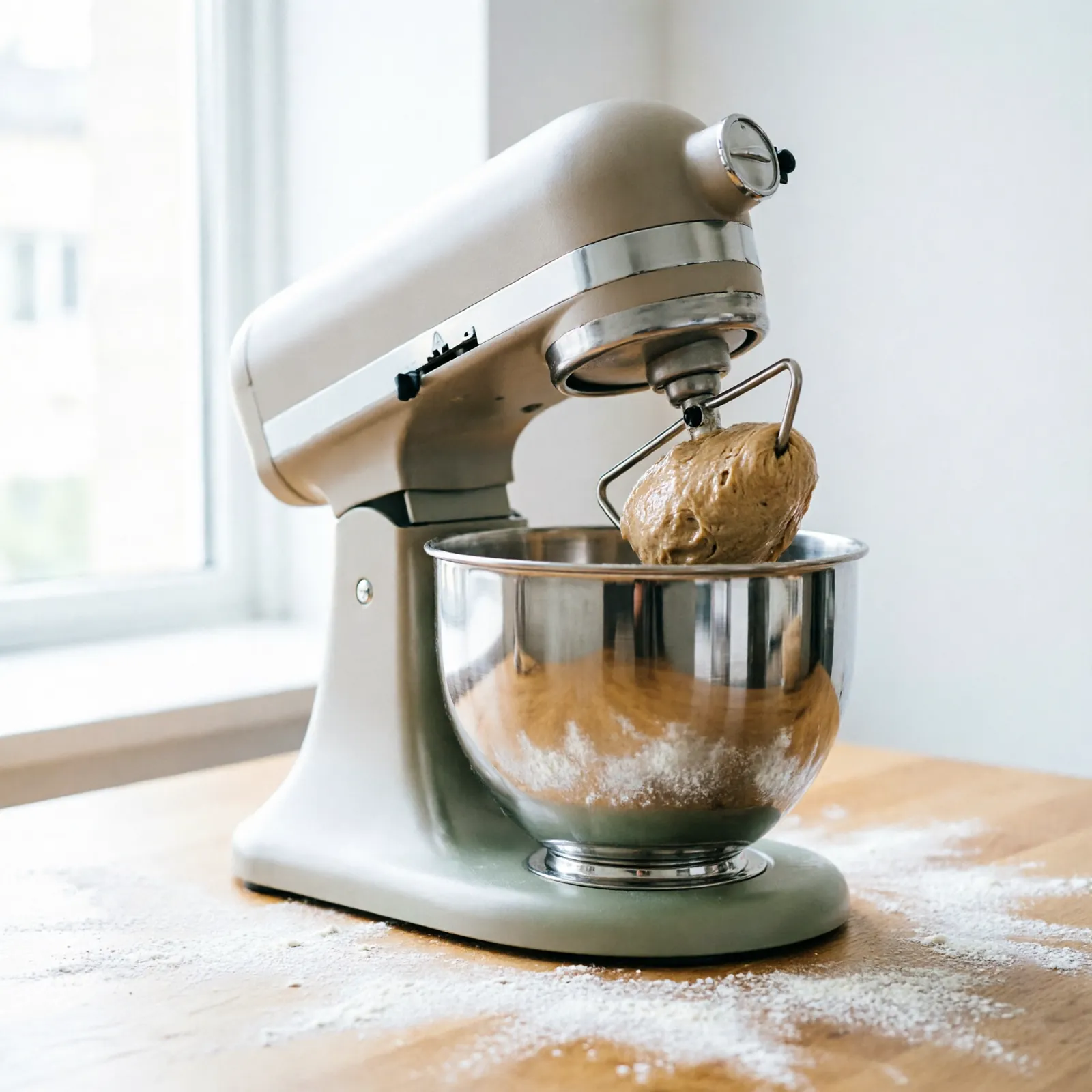
KitchenAid rates the 5-quart Artisan for roughly two standard loaves of dough at a time, and owner reviews broadly agree that it handles this comfortably with the dough hook. Very stiff wholemeal and bagel doughs are where owners occasionally report the head rocking and the motor working hard — a known limit of tilt-head designs, and the reason the manual recommends lower speeds for kneading.
Whipping and aeration
The wire whisk and planetary action are where this design shines. Owners regularly praise how quickly it brings egg whites and cream to peaks, and how little unmixed residue is left at the bowl edges — a common annoyance with cheaper stationary-beater machines. Independent testing of stand mixers generally rates planetary mixers well for this reason.
Stability and noise
At 24 pounds, the mixer’s weight is a spec that matters: it is a large part of why owners rarely report it creeping across the worktop. Expect some movement at the head on high speed with a full bowl. Noise is commonly described as noticeable but not unpleasant.
Longevity and parts
This is the strongest part of the case. Machines from this range routinely turn up in working order from the 1980s and 1990s, and replacement beaters, bowls, gaskets and service parts remain easy to find. The most common long-term issues owners report — grease leaking from the head or worn gears after years of heavy kneading — are repairable rather than terminal.
Specifications
Mixing
- Bowl capacity
- 5 quarts
- Motor
- 325 W direct drive (rated)
- Speeds
- 10, plus fold setting
- Included
- Flat beater, dough hook, wire whisk
Physical
- Dimensions
- 14.1 × 8.7 × 13.9 inches (listed)
- Weight
- 24 lb (listed)
- Bowl
- Polished stainless steel
- Warranty
- 1 year limited
The verdict
Our verdict
The last mixer you are likely to need
There is no way to make this cheap, and we are not going to pretend otherwise. What the evidence shows is that it is the rare expensive purchase that works out over time: it handles the hard jobs, owners keep it for decades, parts remain available, and it retains enough resale value that the real cost of ownership is modest. If you bake regularly, buy it once and stop researching.
Overall rating
4.7/5
Opens Amazon in a new tab. We may earn a commission — it never affects our recommendations.
SnagaReview is reader-supported. When you buy through links on our site we may earn an affiliate commission at no extra cost to you. Read our full affiliate disclosure.
Frequently asked questions
Tilt-head or bowl-lift — which should I choose?
Tilt-head is easier for everyday use and lighter to live with. Bowl-lift is steadier with heavy dough and offers larger capacities. Most home bakers prefer tilt-head; frequent bread bakers often prefer bowl-lift.
Is the 5-quart bowl big enough for bread?
For about two loaves at a time, yes. If you regularly bake three or more loaves, or large batches of enriched dough, move up to a 6-quart bowl-lift model.
Are the attachments worth buying?
The pasta roller and grinder are the attachments owners most often say get regular use. The more niche attachments are expensive and frequently end up in a cupboard. Buy one at a time rather than a bundle.
Why is it so expensive compared with budget mixers?
Metal construction, a direct-drive transmission and long-term parts support. That cost is mostly recovered over decades of use rather than months.